| About Me | Research | Instrumentation | Publications | Email Me! |
:: About Me ::
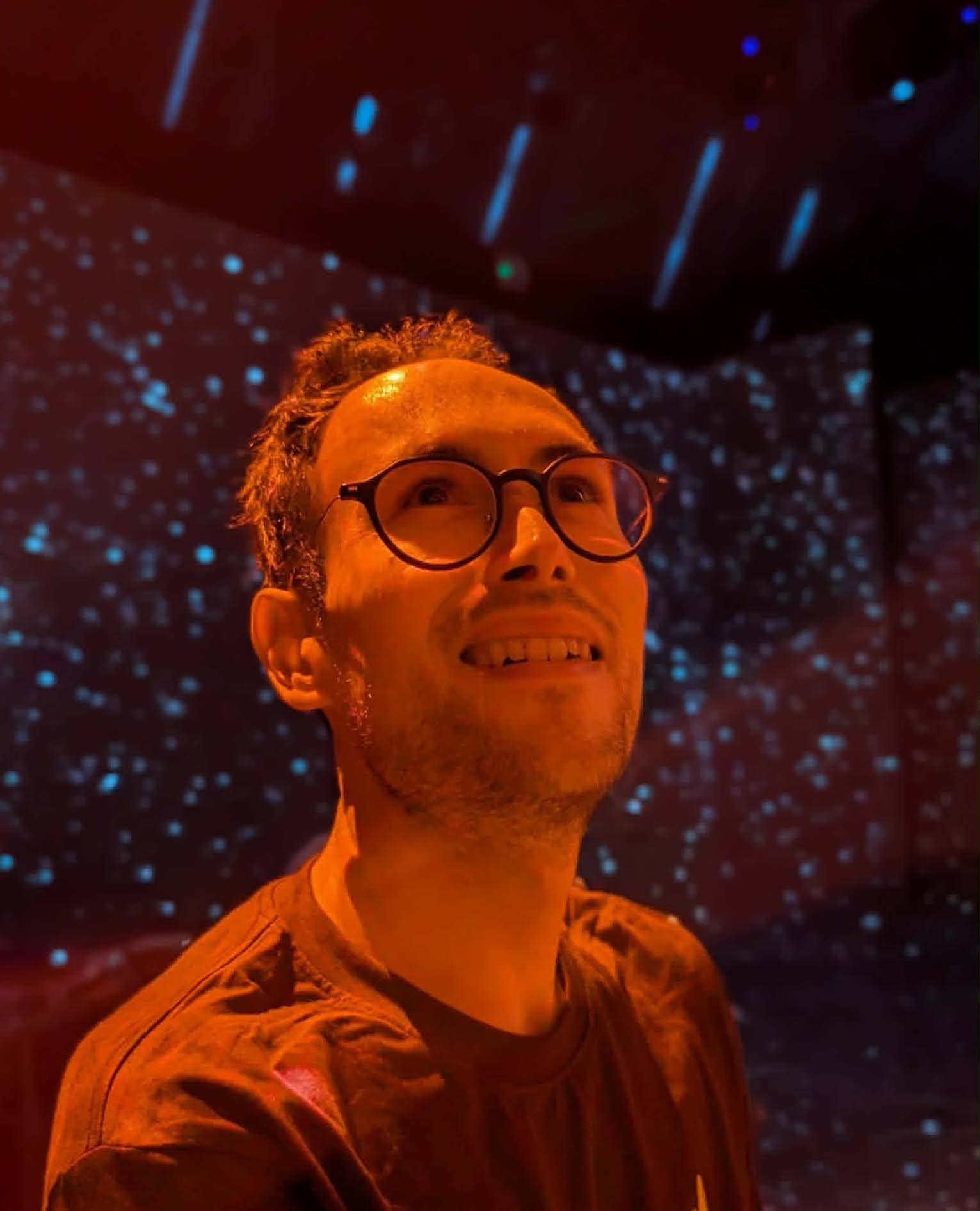
Hello! I am a Senior Postdoctoral Researcher at ETH Zürich and visiting researcher at the University of Cambridge. My primary focus is on the detection and characterisation of exoplanets through the building and use of high-precision radial velocity instrumentation.
When I am not commisioning the HARPS3 spectrograph at the Isaac Newton Telescope, Roque de los Muchachos Observatory, you will find me designing and constructing the next generation of extreme precision radial velocity spectrographs, HARVY.
My specialisms:
- Comprehensive detail of the Echelle spectrograph architecture.
- Ultra stabilisation of optical instrumentation.
- Exoplanetary science, focussed on the radial velocity technique and spectral reduction/extraction and processing.
- Optical design specialising in the Near-UV, Visible and Infra-red.
- Mechanical and optomechanical engineering.
- Project level systems engineering and management.
- Manufacturing and assembly, alignment, integration and testing of ultra-precise, small scale and large (meter class) optical instrumentation.
- Scientific programming and software development, including exposure time calculators.
- Ultra modern web design?
:: Current Research NEW! ::
- Earth-Twin Surveys & EPRV: Developing next-generation extreme-precision radial velocity (EPRV) spectrographs and leading the development of the Highly-repeatable Autonomous Radial Velocity facilitY (HARVY) at ETH Zürich to survey for Earth-like planets around solar-type stars.
- The Terra Hunting Experiment & HARPS3: Building HARPS3 and contributing to the Terra Hunting Experiment (THE) to measure precise radial velocities over decade-long timelines to hunt for Earth-twins. Clark has HARPS3/THE builder status.
- Simultaneous multi-band photometry: Building DUET, a simultaneous InGaAs-CCD, IR-Vis, dual-channel imager for dual band photometry at the SPECULOOS-Southern Observatory to characterize transiting terrestrial exoplanets orbiting ultra-cool dwarfs.
- Roboticisation and upgrade of the Isaac Newton Telescope (INT): Oversaw and managed the project which refurbished the 2.54m INT, turning this historically significant telescope into a modern, fully-autonomous, time-domain astronomy optimised, facility; giving it scientific significance for decades to come.
- General purpose, modular and open-souce exposure time calculator for Echelle spectrographs: Developed a paramaterised exposure time calculator software package that can be adjusted to simulate any echelle spectrograph; it is currently deployed as the principle exposure time calculator for the HARPS3 spectrograph. You can find it [here]
For further details and to read more about this work, see the 'Selected Publications' section.
:: Instrumentation Lab ::
Check back soon! Building in progress...
:: Selected Publications ::
- The roboticization of the Isaac Newton Telescope: the largest robotic telescope in the world. (2026). Ground-based and Airborne Telescopes XI. [DOI]
- Design and evaluation of a white-LED ring for uniform CCD flat-field and contamination monitoring in HARPS3. (2026). Advances in Optical and Mechanical Technologies for Telescopes. [DOI]
- Design and verification of the HARPS3 exposure meter: a dual-band photometer for improved photon-weighted barycentric correction. (2026). [DOI]
- The patient observer: designing a robotic control system for a ten-year EPRV survey. (2026). Software and Cyberinfrastructure for Astronomy IX. [DOI]
- DUET: Design of a simultaneous InGaAs--CCD split-beam imager for ultra-cool dwarf exoplanet transit survey. (2026). Advances in Optical and Mechanical Technologies for Telescopes. [DOI]
- HARPS3 and opportunities for RV follow-up of PLATO targets. (2021). Plato Mission Conference 2021. [DOI]
- NEREA (Near Earths and high-Res Exoplanet Atmospheres), a red/near-IR spectrograph concept for the Gran Telescopio Canarias. (2021). Journal of Astronomical Telescopes, Instruments, and Systems. [DOI]
- A Small Actively Controlled High-resolution Spectrograph Based on Off-the-shelf Components. (2021). Publications of the Astronomical Society of the Pacific. [DOI]
- The Design and Construction of High-Resolution Spectrometers for Exoplanet Discovery and Characterisation. (2020). Queen Mary University of London. [DOI]
- Highly replicable, low-cost, portable, general-purpose, high-resolution spectrometer with applications in stellar studies and exoplanet science. (2019). Techniques and Instrumentation for Detection of Exoplanets IX. [DOI]
- See more at [Google Scholar]
You are visitor number:
Best viewed in Netscape Navigator 2.0 at 800x600 resolution.
Last updated: September 1996 ((a little joke for you there) 2026)